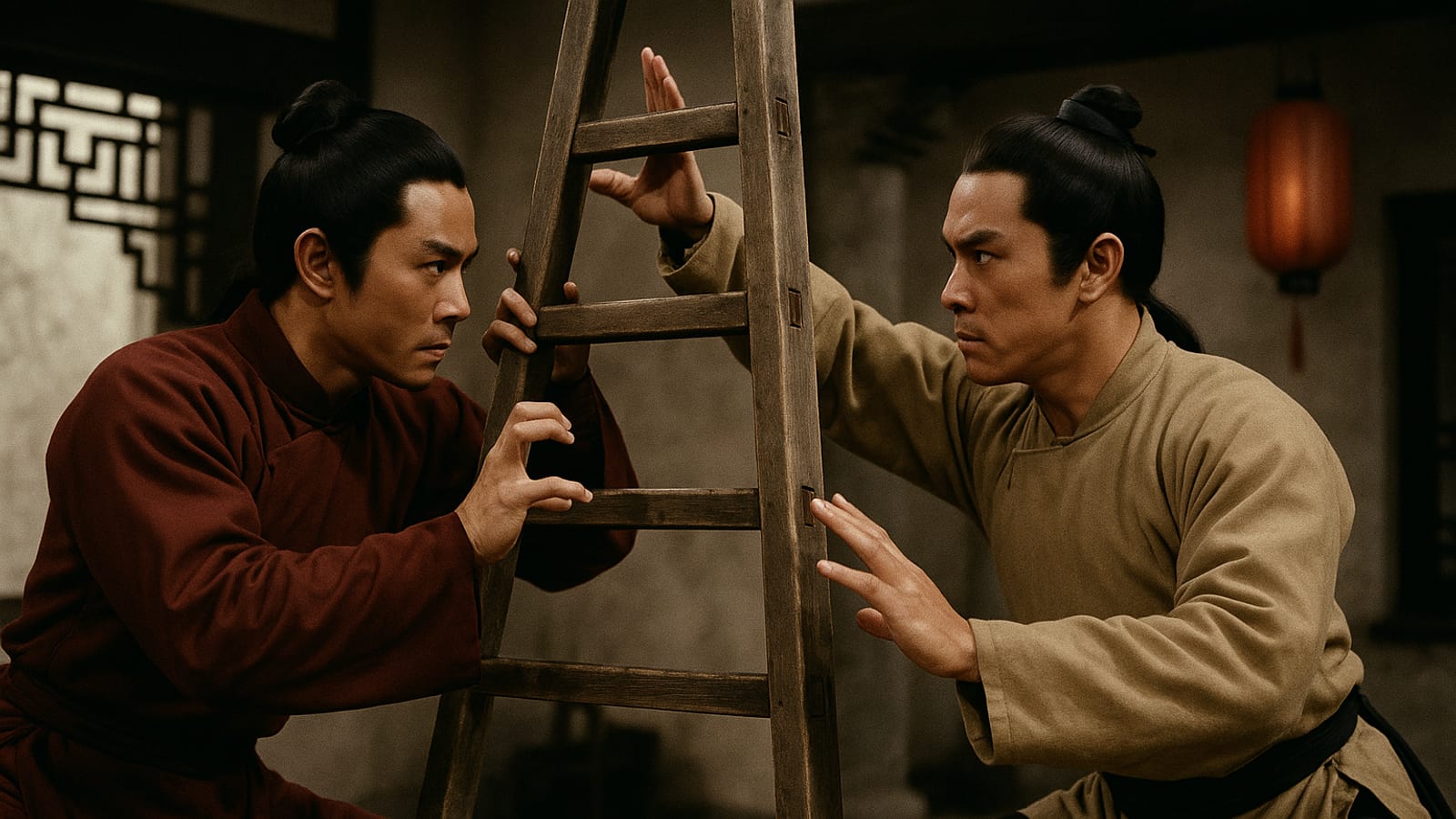
The ladder fight in Dirty Ho runs under three minutes. No plot advancement. No dialogue. No special effects. And it is funnier and more inventive than most action-comedies produced in the last decade. I have watched this scene more times than I can count, and it still gets me. That is not nostalgia talking. That is craft doing exactly what craft is supposed to do.
The Setup: Why a Ladder
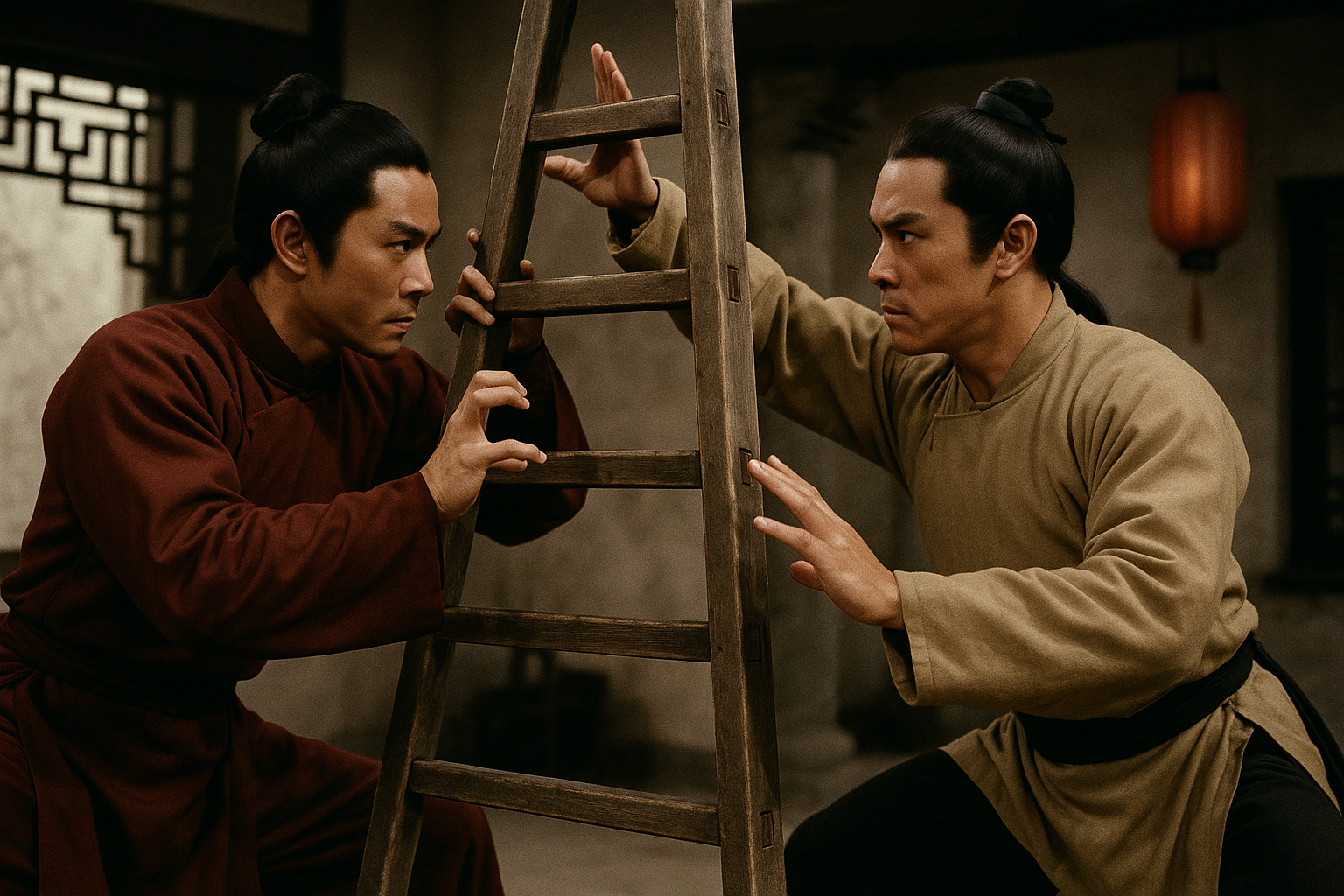
The ladder is not just a prop. It is the whole argument. By forcing the fight onto a narrow, unstable surface, the scene immediately compresses what the performers can do. Every option narrows. Every movement costs something. That compression is what turns a fight into choreography and choreography into something you cannot look away from.
Open-space stunt work gives performers room to breathe, room to reset, room to hide a mistake in a wide shot. The ladder takes all of that away. You have to balance while you strike. You have to think two moves ahead while the whole structure is shifting under you. That is not a limitation on the scene. That is the scene. The constraint is the invention, and the performers are good enough to make you feel every inch of it.
The Choreography: Weight, Balance, and Timing
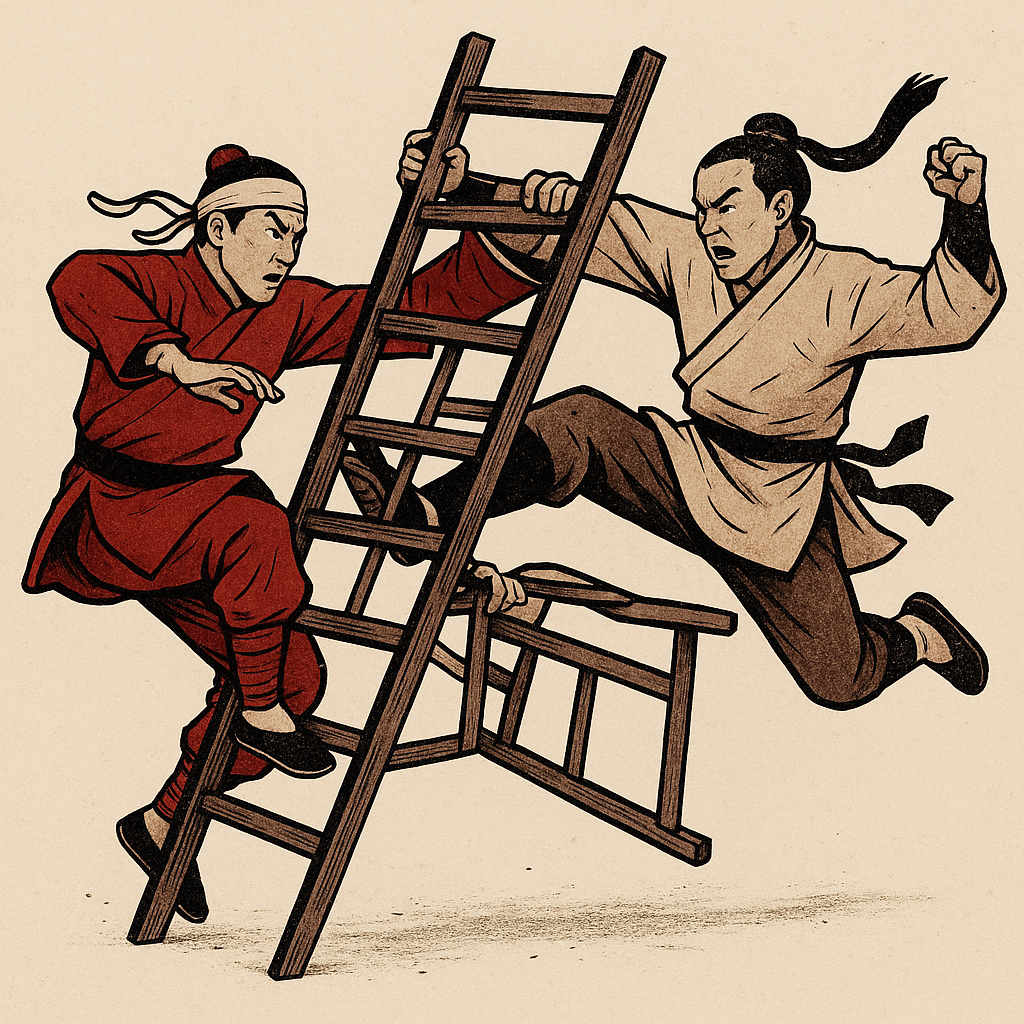
Watch what they do with the ladder itself. They swing it. They climb it. They use it to pin each other into corners that should not exist on a single piece of equipment. The form here is not about power. It is about weight distribution and timing, two things that cannot be faked and cannot be fixed in editing.
The comedy comes directly out of the rhythm of near-falls. Each close call lands because the performers have set up a precise internal logic: this much lean is recoverable, that much is not, and the audience learns that logic without being told. When someone pushes right up against the edge of it, the laugh and the gasp arrive at the same moment. That is not an accident. That is stunt work rehearsed until the timing is locked in the body. The Shaw Brothers productions that hold up best are the ones where the choreography carries that kind of earned precision, and this scene is one of the clearest examples in the catalogue.
Character Through Movement
Nobody says a word in this fight, and you still know exactly who these people are. One fighter moves with a careful, measured quality, reading the situation before committing. The other goes bold and a little reckless, betting on speed over calculation. That contrast is doing real character work. It is also the engine of the comedy, because reckless and careful keep colliding in ways that neither one fully controls.
The fight becomes a conversation conducted entirely in movement, where every punch and dodge tells you something that dialogue would only slow down. This is what the best Shaw Brothers choreography understood that a lot of later action cinema forgot: the fight is not an interruption of the story. The fight is the story. When it is working, you do not need anything else.
Why Modern Action-Comedies Miss This
Modern action-comedies tend to reach for spectacle first and spatial logic somewhere much later, if at all. Quick cuts and digital effects replace the choreographic clarity that lets an audience actually track what is happening and appreciate the skill behind it. When you cannot follow the geography of a fight, you cannot feel the tension. When you cannot feel the tension, the comedy has nothing to push against.
Abandoning constraint costs more than it saves. The inventive spirit that makes a scene like the ladder fight memorable comes directly from the pressure of working inside limits. Without those limits, you get bigger and louder, but you lose the thing that makes an audience lean forward. That trade — spectacle for storytelling depth — is one that underrated films like Dirty Ho quietly expose every time someone watches them back to back with something made forty years later.
The Principle That Transfers
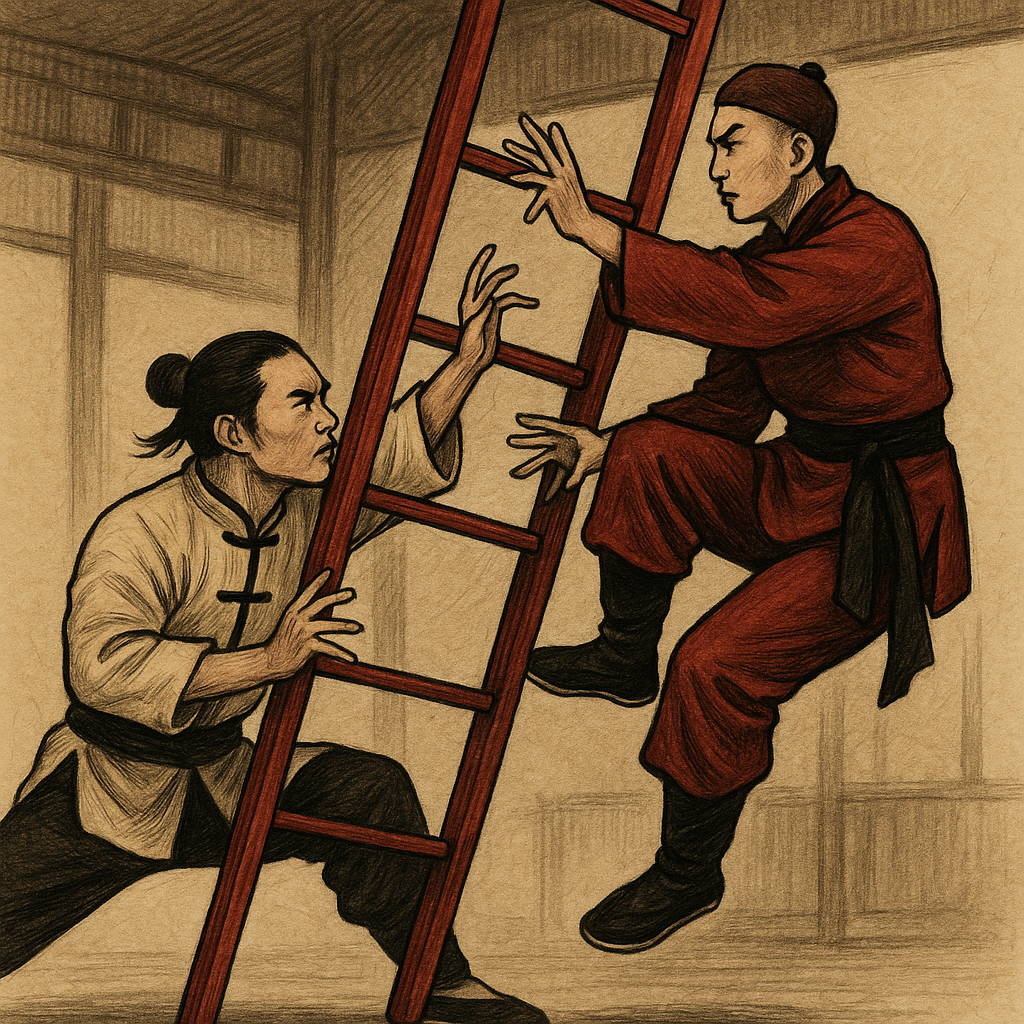
The ladder fight in Dirty Ho is a clean demonstration of something that applies well beyond martial arts cinema: constraint breeds invention. Give performers and choreographers a problem with real edges, and they will find solutions you could not have scripted from a blank page.
- Spotting Constraint: Look for scenes where the environment is an active participant in the fight. Is the space tight? Are there props that dictate how bodies can move? That is creative constraint doing its work, and it is worth studying.
- Why It Matters: Constraints force everyone — performers, choreographers, and audience — to engage more fully. They generate a specific kind of tension that makes scenes stick in the memory long after the credits roll.
When you rewatch Dirty Ho or start working through other films in the Shaw Brothers lineage, keep this principle close. It is a lens that will change what you notice and deepen what you already love about this genre.
If you are new to all of this or have been here for years, Old School Shaolin and Wu is a community built around preserving and celebrating the real history of martial arts cinema. Come find us.
🔹 Keep exploring. Keep watching. Your next favorite scene might be built around something as simple as a ladder.
The Same Principle Across Genres
The ladder fight in Dirty Ho is the clearest example I know, but this principle of constraint driving invention runs through great action filmmaking across genres. In Alien, the narrow corridors and sealed compartments of the Nostromo do not just set a mood. They dictate every encounter, forcing characters into proximity with something they cannot outrun, which is exactly where horror lives. The architecture is the threat as much as the creature is.
Heist films work the same way. In Ocean’s Eleven, the casino’s security systems and the hard deadline are not obstacles layered on top of the story. They are the story. Every constraint the characters hit forces a more inventive response, and the audience stays engaged because the problem keeps getting harder. The lineage of great constraint-driven filmmaking is long, and Dirty Ho belongs in that conversation without apology.
A Checklist for Memorable Action Scenes
For anyone thinking seriously about how action scenes are built, here is what the ladder fight in Dirty Ho actually teaches:
- Define the Space: Establish the environment clearly and make it an active force in the scene. A narrow alley, a crowded room, a precarious ladder — the setting should shape every decision the performers make.
- Use Props Intelligently: Props that dictate movement rather than just decorate the frame are doing real work. The ladder is not background. It is the choreography’s spine.
- Emphasize Timing and Rhythm: Precise timing is not something you fix in the edit. It is built in rehearsal and locked into the body. The fluidity and tension in this scene come from that preparation.
- Develop Character Through Action: Fighting style is character. What a person chooses to do when the pressure is on tells you who they are more honestly than most dialogue can.
- Balance Tension and Humor: When it works, the laugh and the gasp arrive together. That balance is hard to find and impossible to fake.
Questions Worth Sitting With
How important is realism in action choreography?
Realism helps, but consistency matters more. What Dirty Ho asks you to accept is exaggerated, but it is exaggerated in a way that stays true to its own internal logic from the first frame to the last. Once the film establishes its rules, it keeps them. That is what earns the audience’s trust, not strict physical accuracy.
What role does editing play in the success of an action scene?
Editing sets the pace and preserves the clarity of what the performers actually did. The best editing in a fight scene is the kind you do not notice because the choreography is doing the heavy lifting. When editing is covering for weak stunt work, you can usually feel it, even if you cannot name what is wrong.
How You Know a Scene Worked
Measuring the impact of an action scene is not always straightforward, but there are honest signals worth paying attention to:
- Audience Engagement: Are people leaning in or checking their phones? Genuine tension and humor pull focus in ways that are hard to manufacture.
- Critical Attention: When reviewers single out a specific sequence for its creativity and execution, that is a meaningful signal. The ladder fight has earned that attention for decades.
- Rewatchability: People go back to Dirty Ho for this scene. That kind of rewatchability is one of the most honest measures of craft there is.
- Influence on the Genre: Scenes that set a standard tend to show up in the DNA of what comes after. The best Shaw Brothers choreography did exactly that, and this scene is part of that lineage.
Cultural Context Is Not Decoration
The ladder fight is also worth reading as something more than a technical exercise. The martial arts principle of using your environment rather than fighting against it is embedded in the scene’s logic. A ladder is a mundane object. Making it the center of a fight that requires this level of skill and spatial intelligence is a very specific choice, and it connects to a longer tradition of thinking about how a trained body relates to the world around it.
The Shaw Brothers productions that have lasted did not treat cultural context as decoration. They built it into the choreography, the form, the way performers moved through space. That is part of why restoration of these films matters so much. You are not just preserving a print. You are preserving a record of how people trained, what they valued, and what they believed a body in motion could express.
- Research the Context: Understanding the historical and martial lineage behind a film’s choreography changes what you see on screen.
- Recognize Authentic Movement: Fighting techniques rooted in real training carry a quality that borrowed or approximate movement does not. You can learn to spot the difference.
- Read the Props: Objects chosen with intention carry meaning beyond their function. The ladder is a good example. It is never just a ladder.
When filmmakers embed that kind of cultural intelligence into action scenes, the result reaches audiences on more than one level. That is what Dirty Ho did in 1979, and it is why the ladder fight still holds up today.

Leave a Reply