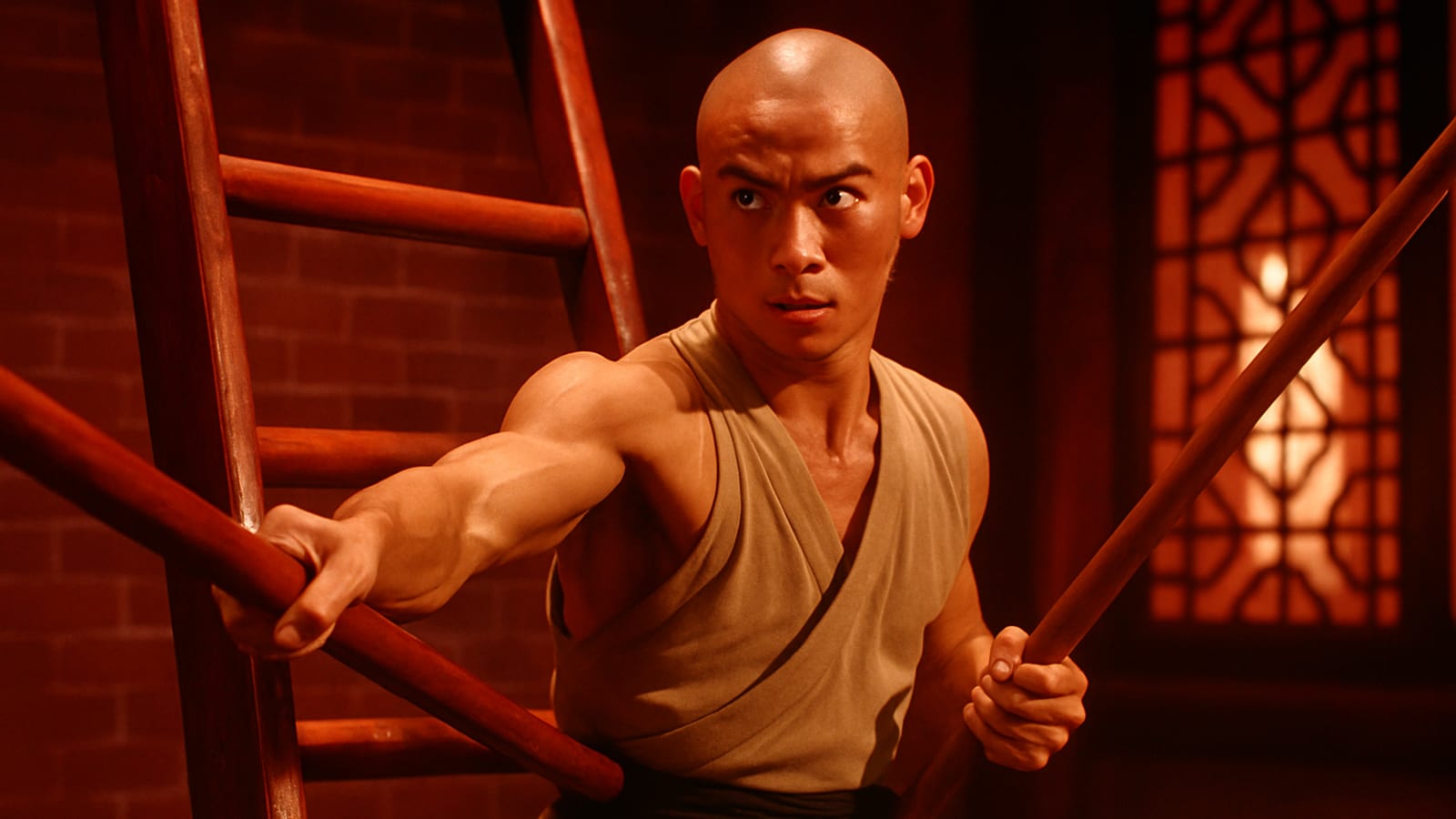
The first time I really watched the ladder sequence in The 36th Chamber of Shaolin, I thought it was a stunt. Second time through, I understood what was actually happening. Gordon Liu wasn’t showing off. He was fighting the ladder itself. This scene is a masterclass in choreographic problem-solving—Liu adapting his Shaolin techniques to the demands of a narrow, vertical space that has no interest in cooperating with him. Here is why this sequence is worth your full attention, and how it fits into everything the film is trying to say.
Why the Ladder Matters in the Film’s Logic
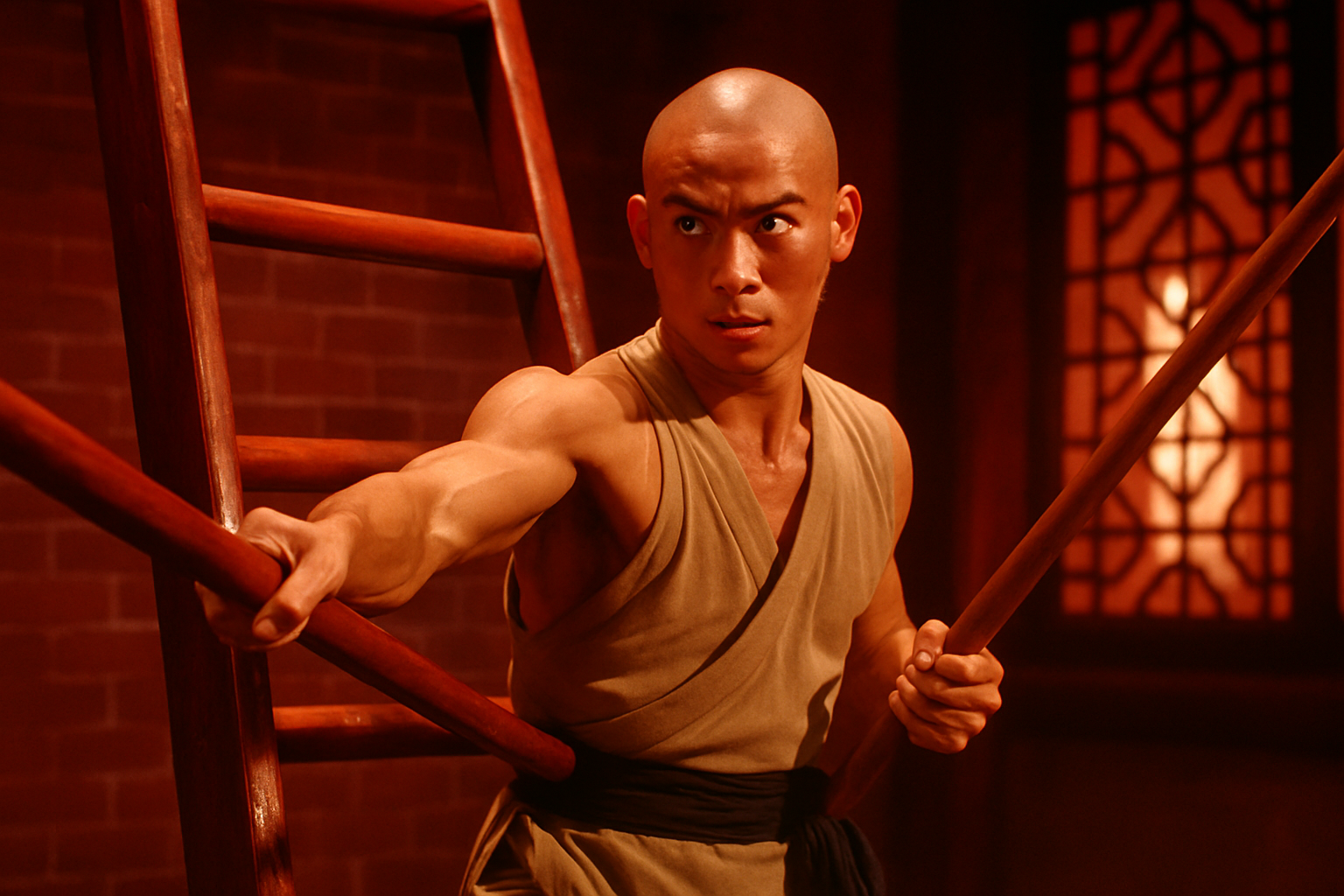
The journey through the chambers in The 36th Chamber of Shaolin is a rite of passage—a sequence of trials designed to refine body and spirit together. The ladder test is not just another obstacle on the list. It is a deliberate challenge that strips away everything a fighter normally relies on: stable ground, free footwork, room to breathe. Positioned midway through Liu’s journey, it marks a turning point where physical training and mental discipline have to become the same thing. The ladder is a metaphor, yes, but it earns that reading because the craft behind the scene is real. The film’s message about inner strength and adaptability only lands because Liu makes you feel the difficulty in his body, not just his expression.
The Vertical Problem: Why a Ladder Changes Everything
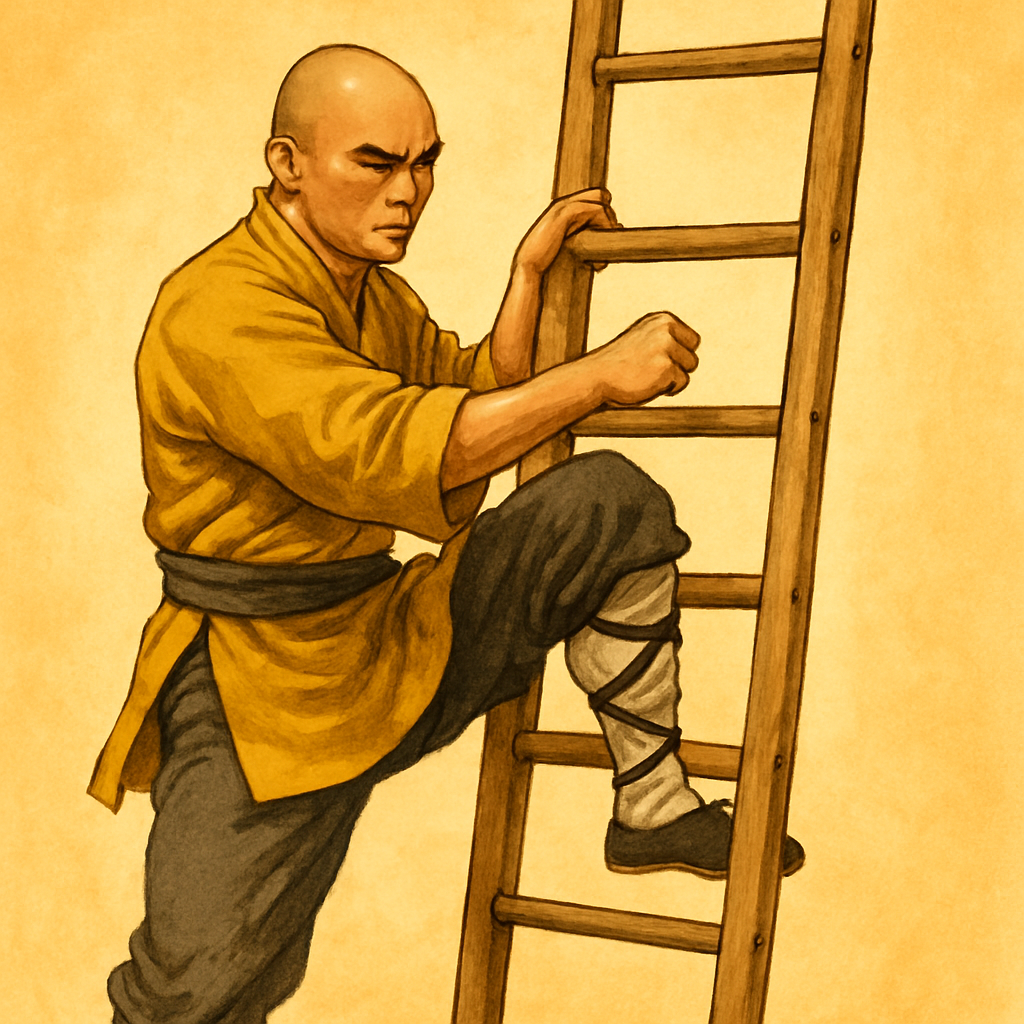
Traditional kung fu is built on footwork and stances that assume solid ground beneath you. Take that away and the whole system has to renegotiate with itself. On a ladder, mobility collapses to almost nothing. Every technique has to be compressed, redirected, reconsidered. The narrow space demands precision that flat-ground training does not prepare you for, and any misstep is not just a tactical error—it is a fall. Meanwhile, an opponent on the ground can move freely and exploit every constraint the ladder creates. The ladder becomes a battleground where every rung and rail is simultaneously a weapon and a hazard, and the fighter has to hold both truths at once.
Once you understand how the ladder disrupts kung fu’s foundational logic, you start seeing similar choreographic thinking in other Shaw Brothers work. The ladder fight in Dirty Ho is worth watching back to back with this one—the choreography turns the same simple prop into an entirely different tactical problem.
What Gordon Liu Actually Does on the Ladder
Liu’s performance here is not about acrobatics. Watch what he does with the rails. He uses them as both support and weapon, leaning into them to generate force without sacrificing the stability he cannot afford to lose. His weight distribution is constant, quiet work—you almost miss it because he makes it look like thinking rather than effort. Traditional Shaolin techniques get modified in real time to fit the geometry of the ladder, and there are moments where you can see him improvise, adjusting mid-movement to stay fluid when the structure pushes back.
That blend of choreography and improvisation is what separates this sequence from a rehearsed stunt. Every move is a calculated response to where the ladder puts him. Liu’s lineage in Shaolin training shows not in the flashiness of the strikes but in the problem-solving underneath them—the same grounded, technical approach that defines his work across his entire career with Shaw Brothers.
The Choreography Beneath the Spectacle
The brilliance of this sequence is in how the choreography holds together under pressure. Safety considerations shaped what could actually be filmed, and those constraints forced creative solutions that made the scene stronger. Camera angles do real work here—they reveal the mechanics of each movement while preserving the sense of genuine danger. When movements repeat, it is not padding. It is economy of choreography, the principle that every action has to earn its place in the fight.
This is Shaw Brothers craft at its most honest. The ladder becomes a dynamic partner in the fight rather than a backdrop to it. If you want to follow this thread further, the influence of Shaw Brothers fight choreography on later media is a subject worth spending time with—the lineage runs deeper than most people realize.
How This Sequence Fits Gordon Liu’s Screen Style
This ladder sequence is not an outlier in Liu’s body of work. It is a concentrated expression of everything he stood for as a performer. He was never interested in wire work for its own sake. His preference was always for grounded, technical fighting where the craft was visible in the body, not hidden behind editing. His Shaolin training gave him a problem-solving approach to the fight—you see him reading the environment and responding to it, not just executing a preset routine.
That approach sets him apart from a lot of what was happening in Shaw Brothers films at the time, where spectacle often took priority over legibility. Liu’s stunt work is impressive precisely because it looks like it costs him something. The ladder sequence is the clearest example of that commitment on film.
Why This Matters to How You Watch the Scene
Understanding the tactical logic behind the ladder sequence changes what you see when you watch it. On a rewatch, look for the moments where Liu is managing genuine difficulty—where the balance between controlled execution and real physical challenge becomes visible. Recognizing the thought behind each movement turns the scene from spectacle into something closer to a conversation about what martial arts cinema can actually do when the craft is taken seriously.
This is why old school kung fu films keep finding new audiences. There are layers underneath the surface action that reward attention. The ladder sequence in The 36th Chamber of Shaolin is one of the clearest examples of that depth the genre has to offer, and it points directly toward the rest of Gordon Liu’s work if you want to keep pulling the thread.
Reading the Ladder Through Martial Arts Principles
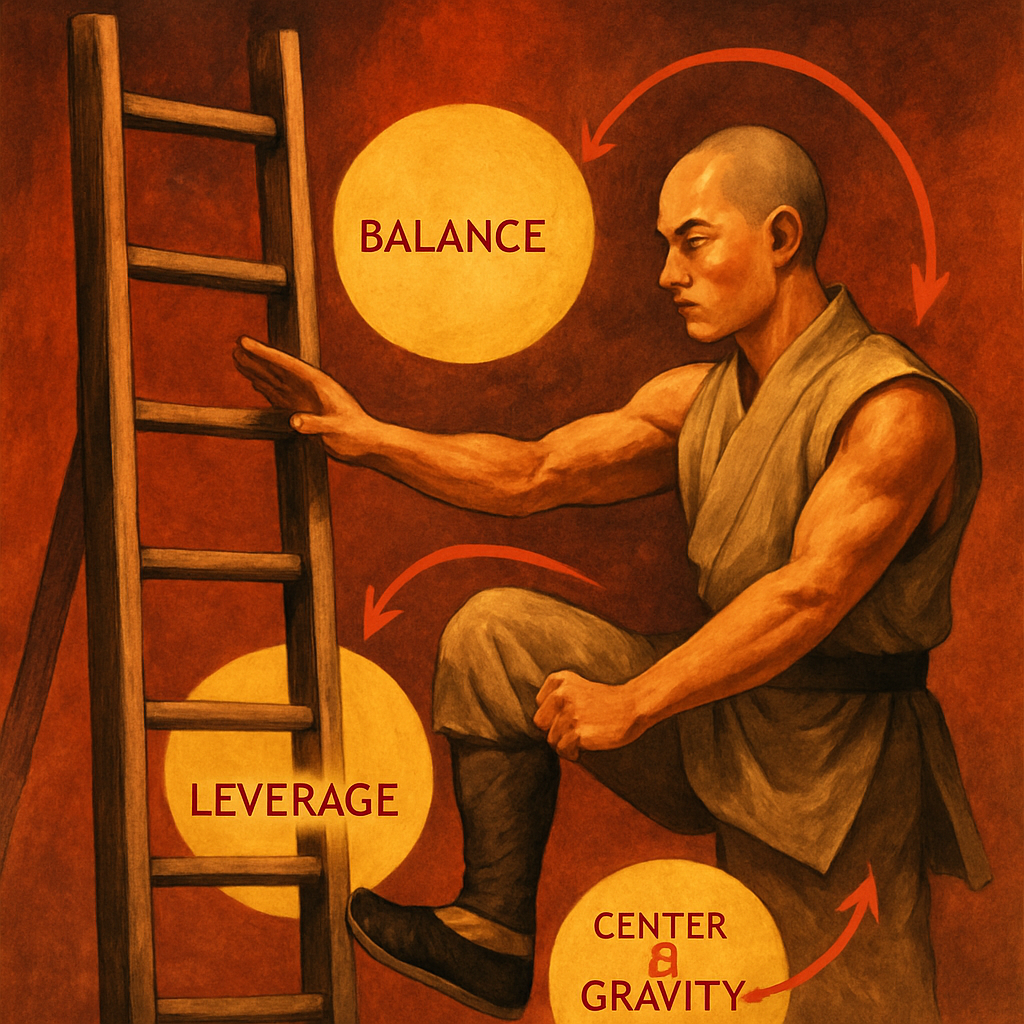
To fully appreciate what Liu is doing in this sequence, it helps to watch it through the lens of three specific martial arts principles: balance, leverage, and center of gravity. These are not abstract concepts here. They are the practical tools Liu is working with in every frame, and once you know to look for them, the scene opens up completely.
Balance is the first thing the ladder attacks. Liu’s stance narrows dramatically from what Shaolin training normally demands. Watch how he shifts his weight in small, constant adjustments—keeping his center of gravity low, preventing the ladder from tipping the equation against him. It mirrors the logic of a horse stance but compressed into a vertical plane.
Leverage is where Liu turns the ladder’s constraints into something he can use. Rather than fighting the rails, he leans into them at strategic moments to generate force without sacrificing stability. This is the same principle that shows up across martial arts traditions wherever the environment gets recruited as part of the fight.
Center of gravity is the thread that holds the whole sequence together. Liu keeps his center aligned with the ladder’s axis throughout, which is what allows movements that look effortless to actually be controlled. That control is the product of serious training—core strength and spatial awareness developed over years, not weeks.
What Martial Artists Can Take From This
There are real practical insights in this sequence for anyone who trains. Working on uneven or narrow surfaces builds balance and coordination that flat-ground training simply does not develop the same way. The adaptability Liu demonstrates—reading an environment and adjusting technique in real time—is a skill that has to be trained deliberately.
- Balance Drills: Practice holding stances on narrow platforms. The instability forces your body to find solutions your regular training does not require.
- Leverage Techniques: Use walls or rails during sparring to develop an understanding of how the environment can work for you rather than against you.
- Core Strengthening: Build the core strength that makes center-of-gravity control possible on unstable surfaces. This is the foundation everything else in the ladder sequence rests on.
Through these applications, the principles Liu embodies in the film become transferable to actual practice—a reminder that the best Shaw Brothers choreography was always grounded in something real.
The Ladder’s Influence on How Martial Arts Gets Trained Today
The ladder sequence in The 36th Chamber of Shaolin did not just influence cinema. It contributed to a broader conversation about how environmental constraints can sharpen a martial artist’s fundamentals. Contemporary schools increasingly use ladder drills to develop footwork, agility, and coordination in ways that traditional mat training does not replicate.
Footwork and Agility
Agility ladders laid flat on the ground have become standard equipment in many martial arts academies. The drills they support—fast, precise foot placement under pressure—echo the ladder sequence’s emphasis on balance and coordination. Practitioners learn to move quickly while staying accountable to where their feet actually land, which translates directly to sharper footwork in sparring.
Coordination and Reflex Training
Ladder exercises that incorporate hand movements and striking techniques while navigating the rungs build the kind of multitasking that the ladder sequence demands of Liu. Reacting to a dynamic environment while maintaining form is a skill that has to be practiced under conditions that replicate the pressure—not just rehearsed in isolation.
Spatial Awareness
Training with ladders also develops spatial awareness in ways that matter in real combat situations. Practitioners become more conscious of their body’s position relative to their surroundings, which is exactly the awareness Liu is drawing on throughout the sequence. Quick adjustments in confined or unstable spaces require that awareness to already be built in—not improvised in the moment.
The fact that a Shaw Brothers sequence from 1978 still informs how martial artists train today is not a coincidence. It is a measure of how seriously the people who made that film took their craft. Gordon Liu’s work on that ladder deserves to be understood on those terms. For further exploration of this topic, consider reading about the soundscapes of the Shaolin and how they enhance the cinematic experience, or delve into other martial arts film analyses by Old School Shaolin and Wu.

Leave a Reply